
Best Wreck Dives in KSA for Your Next Red Sea Adventure.
Saudi Arabia’s Red Sea has much more to offer beyond colorful coral reefs and reef fish.There are plenty of wrecks here that have been decades underwater and become part of the sea’s natural scenery for divers to explore.
The best wreck dives in KSA range from accessible sites near Jeddah to deeper wrecks that require more experience and careful preparation.There are those wrecks that still maintain parts of their initial shape, while others have been turned into something completely different thanks to corals and sea life.
That variety is exactly what makes wreck diving here so rewarding.
Why Saudi Red Sea Wreck Dives Feel Different?
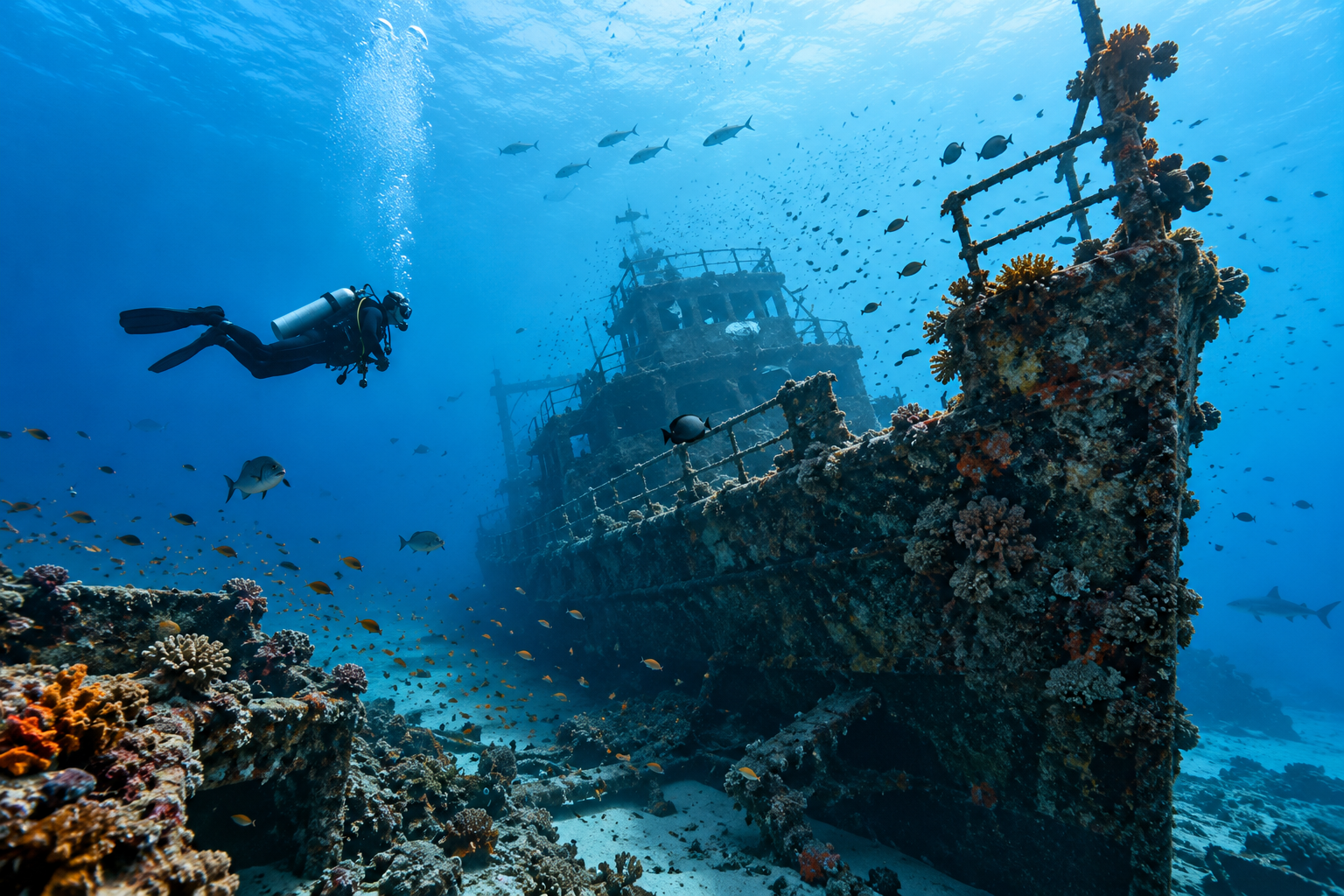
When a ship remains underwater for years, coral begins to grow across its surfaces, fish find shelter within its openings, and the wreck gradually becomes part of the surrounding reef ecosystem.
This is what makes Saudi Red Sea wreck dives fascinating even for divers who are more interested in marine life than maritime history. You can find yourself diving down expecting to inspect a wreck and spending most of your time observing reef fish, rays, moray eels, barracudas, or sharks living around it.
Moreover, the coast of Saudi Arabia in the Red Sea area provides divers with opportunities to explore not only wrecks but also standard dive sites of the Red Sea.
Some wrecks around Jeddah and Yanbu are especially well known, and each one brings something different to the dive.
Jeddah Shipwreck Diving Begins with the Cable Wreck.
The Cable Wreck is one of the names divers quickly come across when exploring Jeddah shipwreck diving.
This vessel used to be named Staphonos and it sank in the year 1978 carrying steel beams, chain link fence, asbestos, and cables. It would not be the only wreck in the area that would become more famous for the cargo it carried than the name of the ship itself.
Today, the wreck rests southwest of Jeddah near Abu Tair Island at a depth of around 24 meters.
Sunlight is able to reach the wreck at this depth and marine life found in the vicinity includes whitetip sharks, goatfish, and blue-striped snappers.
Currents can sometimes make the dive more challenging, so conditions should always be checked before entering the water.
Divers who want to experience wreck structure along with marine life but do not want to move directly into the deeper locations can consider this site.
Ann Ann Wreck Diving Brings a Bigger Challenge.
For divers looking for a larger and more challenging wreck, Ann Ann stands out.
The vessel was sunk near Abu Faramish Reef in 1977. It is known as the largest wreck dive off the coast of Jeddah.
Most of the wreck is still distinguishable; some of the recognizable spots include the area of the captain’s cabin and an unloaded cargo hold. Coral growths have settled upon the vessel’s propeller as well.
Marine life seen near Ann Ann includes whitetip sharks, tuna, snappers, blue-spotted rays, goatfish, filefish, and coral groupers.
Due to the depth and the current, the wreck of Ann Ann is best for intermediate and advanced divers.
Ann Ann wreck diving can also offer penetration opportunities for appropriately trained divers. The wreck has parts that can be found at various depths, but seeing an entrance doesn’t necessarily mean that one should penetrate the wreck.
Various factors, such as wreck penetration depth, visibility, gas management, entrances and overhead environment, need to be considered before attempting a penetration dive.
The Glaros Chicken Wreck Is a Different Kind of Story.
In November of 1976, the MV Glaros ran aground in Jeddah Creek. After its crew was saved from the ship, it was finally sunk with a load of frozen chicken on board.
Its unusual cargo gave the wreck the nickname divers still use today: Chicken Wreck.
This wreck lies between two reefs and is visited by all kinds of marine species, such as moray eels, barracudas, angelfish, and butterflyfish.
Its position between two reefs and approachable dive profile make it one of the more accessible wrecks in the area.
A novice wreck diver looking to gain experience in wreck diving can benefit from diving at the Chicken Wreck as an opportunity to swim alongside a wrecked ship without embarking on an advanced wreck dive right away.
Marble Wreck Jeddah Keeps the Story Closer to the Surface.
For divers looking for a shallower wreck experience, Marble Wreck is another site worth considering.
The wreck has its greatest depth of about 18 meters, while the shallowest area is around eight meters deep.
The wreck takes its name from the cargo it once carried: marble slabs.
Corals and oysters now cover parts of the vessel, while lionfish have also been spotted around the site.
There is another wreck which is sometimes dived together with this one because of proximity, and that is Ann Ann.
This wreck is an example of how the sunken ships in the Red Sea become something totally different.
Iona Wreck Yanbu Adds Mystery to the Dive.
Head north toward Yanbu and the wreck-diving experience begins to change.
Iona Wreck Yanbu is one of the most recognizable wrecks in Saudi Arabia and at the same time is one of the most mysterious.
The wreck was discovered by divers in the 1980s and is believed to date back to World War I.There were indications that the ship had run ashore at great speed while champagne bottles were lying around the ship.
The history of the wreck is unclear as there were multiple speculations regarding its end.
The fan tail of the wreck lies at a depth of 20 meters under the sea while visibility at Yanbu is really good. Moreover, the region itself is known for its clean water and offers several other famous dive spots other than the Iona.
Its mysterious history, depth, and clear Yanbu waters give divers several reasons to add Iona to their list.
Boiler Wreck Saudi Arabia Is a Dive of Dramatic Depths.
Few wrecks around Jeddah have a depth profile quite like the Boiler Wreck.
The adventure for scuba divers starts in open water by descending to a shelf at about 45 meters and then ascending towards the bow which sits at less than three meters below the surface.
Not much of the ship itself survives today with only two boilers being the most distinctive parts that earned it the current nickname.
Surrounding it, there are coral reefs and caves along with reported sightings of moray eels, sharks, and manta rays.
At around 100 years old, it is also considered one of the oldest wrecks along Jeddah’s coastline.
The great difference in depth requires divers to have proper training, certification, experience and planning prior to the dive.
How Wrecks Become Artificial Reefs?
One of the most interesting aspects of wreck diving occurs well after the sinking of the vessel.
Over time, marine life begins to claim the wreck as its own.Corals will grow over metal, fish will take refuge in the holes, and predators will start coming to where small marine creatures live.
The result is an artificial reef diving experience where the wreck itself becomes part of a living underwater habitat.
In Jeddah’s wrecks, one might find reef fish, barracuda, moray eels, lionfish, groupers, rays, turtles, corals, and sponges.
It also means that wreck divers have to be as respectful of a shipwreck as they are of a natural reef.
Pick the Wreck That Matches Your Experience.
The best wreck for you is not necessarily the deepest or the most famous.
Chicken Wreck and Marble Wreck may suit divers building their wreck experience, while Cable Wreck introduces greater depth and potentially stronger currents.
Ann Ann offers an even bigger structure for advanced divers to explore, Iona offers wreck diving along with one of the marine mysteries of Saudi Arabia, and Boiler Wreck offers increased difficulty of diving in terms of depth.
It is important to take into consideration several factors prior to planning to do a wreck dive, such as the current, certification level, buoyancy control skills, maximum depth of the dive, and whether there is an overhead environment involved.
Find Your Next Red Sea Wreck with Mermates.
The best wreck dives in KSA reveal a completely different side of the Red Sea.
Instead of simply following a reef, you can swim alongside vessels that have spent decades beneath the surface, watch marine life reclaim their structures, and experience a piece of Red Sea history underwater.
Whether you are planning your first wreck diving experience or looking for more challenging sites such as Ann Ann, Iona, or Boiler Wreck, Mermates can help you find a Red Sea dive that matches your certification, experience, and interests.
The Red Sea is already famous for its reefs, but sometimes the most memorable dive begins with a ship resting beneath the surface.