Where Will the Red Sea Best Diving Spots Take You Next?
Some dive sites deserve more than a few hours of exploration.
Liveaboard trips offer something different: you sleep on the Red Sea, share meals onboard, and wake up ready for your next dive.
It means that you will not need to travel from the dive site to the hotel and will not go through the same route from the marina every morning. You will have your equipment nearby, discover some new diving spots and even be able to reach some remote spots.
This is the kind of experience built for travelers who want diving to be the heart of their trip.
You can start the day by visiting some offshore reef, come back to the boat to have breakfast, relax and make your way to a new place to dive. Some days you will focus on corals, other days – will meet some unusual species of marine creatures.
This is the advantage of liveaboards because they are about diving as well as having fun outside the water.
With Mermates, you will be able to pick a vacation according to your certifications, needs and preferences.
Let the Red Sea Dive Safari Take You Beyond the Usual Reefs.
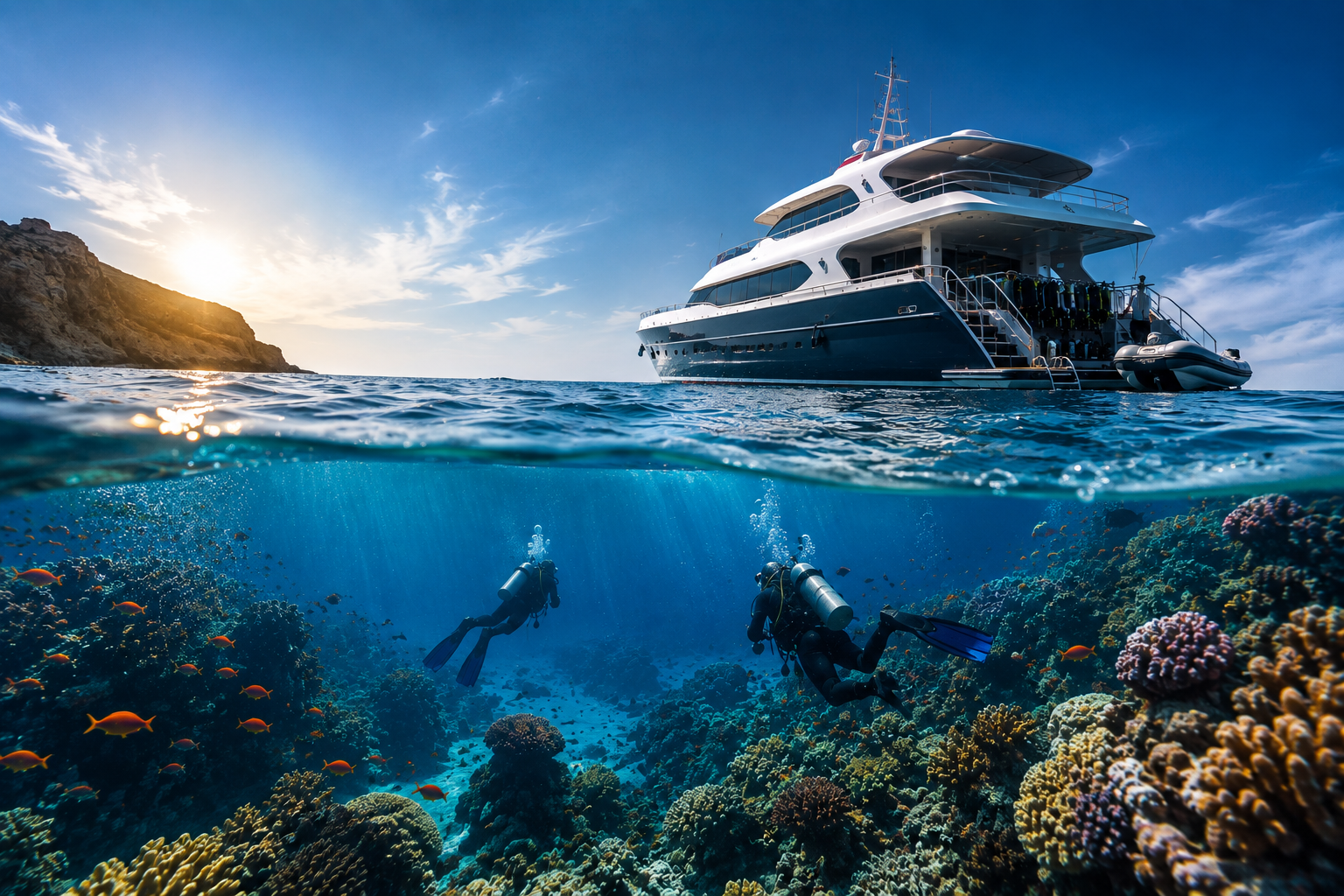
The key aspect of a liveaboard adventure is that it takes away the single largest obstacle of regular diving trips: coming back to the shore.
When it comes to regular days out, there is a limit to how far the boat can go before the journey back to the marina takes too long.
Liveaboards follow a completely different schedule.
While you sleep or rest, your vessel is able to move and get you to another dive location. This opens up possibilities of reaching sites further away and making your schedule include various underwater environments without having to return to the starting location.
This also makes diving more continuous.
There is no need to pack and unpack your gear, and your gear can be always arranged on the dive deck. You can concentrate on preparing for the next dive.
The difference becomes clearer as the days pass because you are no longer constantly switching between life on land and life underwater.
Diving will become your daily routine.
Leave the Shore Behind on a Red Sea Dive Safari.
A dive safari in the Red Sea is all about travel.
Instead of selecting a single reef to spend an entire day on, the trip itself links different diving settings.
One site may offer you spectacular reef wall, while another would provide the right coral formations or open-water diving. Offshore there might be totally different conditions to dive in.
That variety also makes marine life encounters feel less predictable and more rewarding.
Marine life does not follow a booking schedule, and no specific encounter can be guaranteed.
A good dive safari should still feel worthwhile even if sharks, rays, turtles, or large schools of fish do not appear. The real value lies in the complete Red Sea experience: different reef systems, changing dive conditions, varied sites, and the people you share the journey with.
And here comes another strong point of liveaboards which may not be achieved with single day trips.
It is not just about diving another site.
The journey continues through the Red Sea.
Discover the Rhythm Behind a Liveaboard Daily Routine.
A typical liveaboard daily routine often starts early, but for divers, that is part of the appeal.
You can wake up and find yourself at the site where the first dive is going to happen. Before entering the water, dive briefings cover the route, entry and exit points, expected depth, currents, safety procedures, and anything specific to the site.
Then it’s time for the first dive.
After coming back to the boat, your schedule becomes centered around diving and recovery rather than sightseeing.
A breakfast or a meal could be next, along with surface intervals that give you some time between dives. During these intervals, the boat seems most relaxing. The divers discuss their observations, review cameras, log dives, hydrate, or just relax outside watching the sea.
Depending on the schedule and conditions, another dive happens sometime in the morning and more diving can occur in the afternoon.
When conditions and the itinerary allow, night dives can add another dimension to the experience. A reef that you have seen in daytime may seem totally different in the darkness since various species are awake then, and your view is limited by the light from your torch only.
The schedule is repeated, but not the underwater experience.
Make Your Saudi Diving Expedition About More Than Dive Numbers.
It is easy to evaluate a Saudi diving trip based on one parameter only:
How many dives can I do?
More does not necessarily mean better, however.
Several dives per day in succession take energy, proper preparation, hydration, proper experience level, and knowledge of when the body needs to rest.
There might also be consideration of nitrox diving by the certified individuals, when it is provided aboard. The decision to use it or not depends on the planned dives, procedures, certifications and other requirements, not just the wish to spend more time underwater.
Your certification and experience are important as well.
A relaxed reef itinerary and a route involving strong currents, deeper dives, or challenging entry points should not be treated as the same experience.
Before making your reservation, know what is expected of you on the trip.
Ask about typical depths, currents, required certifications, recommended experience levels, the number of dives, and the types of sites included.
The aim is not to end up with the maximum number of dives made for the week.
The goal is to end up wishing to dive the Red Sea again.
Pack Smarter for Your Liveaboard Trip.
Packing for a liveaboard dive trip is much simpler if you remember one thing: space is an issue on a boat.
You are unlikely to need the same wardrobe you would pack for a city break. Most of your time will revolve around diving, eating, relaxing, and preparing for the next dive, so pack around those activities.
Pack your certification cards, dive equipment, dive computer, swimwear, lightweight clothing, sun protection, toiletries, medications, and photography equipment.
If you are susceptible to motion sickness, address it before your voyage and not during your trip at sea.
It is also important to consider the boat’s amenities.
Tanks, weights, towels, rental gear, toiletries, charging facilities, and other amenities may differ between boats.Soft bags might be more useful than hard bags due to space constraints aboard the ship.
Finally, do not make the packing process about competing with your dive buddies to bring more equipment.
Only pack what you need to enjoy several days at sea.
Are Liveaboard Trips the Right Choice for You?
Liveaboard trips are not automatically better than day diving. They simply suit a different kind of diver and a different kind of trip.
If you expect your vacation to be packed with visits to restaurants, sightseeing, night life on the mainland, and some diving here and there, then staying in hotels could work better for you.
But when diving is the main reason you are traveling, a liveaboard changes the entire experience.
You could wake up closer to the diving spots, discover different dive sites during one trip, spend your time diving surrounded by other divers, and see the Red Sea without every dive becoming an expedition.
Of course, you also need to be comfortable spending several days onboard, adapting to changing sea conditions, sharing spaces with other divers, and accepting that the itinerary may change depending on weather and diving conditions.
That is why booking a liveaboard should start from defining your desires, and not just picking a boat.
At Mermates, we help our clients analyze their whole journey: diving skills, preferences, requirements of the itinerary, and the way they would like to spend their days in the Red Sea.
Because sometimes, the right way to see the Red Sea is to stop coming back to the shore after each dive.
Ready to wake up closer to your next Red Sea adventure? Explore liveaboard trips with Mermates and find the experience that fits the way you dive.