Scuba Diving and Mental Health: The Ocean's Secret Therapy
Finding Silence in the Deep: How Scuba Diving and Mental Health Amidst Geopolitical Noise
We live in an era defined by hyper-connectivity, where the boundary between global crises and our personal living spaces has been entirely erased. For those of us living in the Middle East, this reality is uniquely pronounced. Every ping of a smartphone notification brings a relentless stream of regional geopolitical news, global economic uncertainties, and rapid socio-economic changes. While staying informed is important, this constant barrage can create a heavy, often unacknowledged, psychological burden.
Yet, just beyond the bustling streets of Riyadh and the dynamic coastal development of Jeddah lies a profound, silent sanctuary. The Red Sea and the Arabian Gulf offer more than just picturesque coastlines; they provide a much-needed psychological refuge. In our current political and social climate, scuba diving and simply spending intentional time by the sea are no longer just recreational weekend activities. They have evolved into essential tools for mental grounding, offering a powerful, mandatory digital detox and a profoundly unique form of moving meditation.
Mental health professionals have increasingly begun to recognize a phenomenon colloquially known as “Headline Stress Disorder.” The 24/7 news cycle, particularly concerning Middle Eastern geopolitics and global conflicts, does not just inform us; it alters our neurochemistry. Constant exposure to alarming headlines elevates cortisol levels, keeping our bodies in a prolonged state of low-grade “fight or flight.” We wake up to breaking news and go to sleep after scrolling through complex political analyses, inducing a persistent hum of background anxiety.
Furthermore, these geopolitical situations often leave individuals grappling with the “illusion of control.” We invest immense emotional energy into reading about and analyzing events over which we have absolutely no personal influence. This dynamic is a fast track to mental fatigue, emotional burnout, and a deep sense of helplessness.
Compounding the issue is our modern approach to “relaxation.” When we feel stressed by the state of the world, we often turn to our screens—binge-watching television shows or aimlessly scrolling through social media feeds. However, these traditional relaxation methods are frequently just different channels of the exact same digital noise that caused our stress in the first place. They do not allow the brain to genuinely disconnect and reset. We need a more radical departure from the surface world.
The Psychological Toll of the "Current Climate"
Long before scuba diving became a popular recreational sport, humans instinctively understood the healing power of water. Marine biologist Wallace J. Nichols coined the term “Blue Mind” to describe the mildly meditative state we fall into when we are near, in, on, or under water. It is the scientific antidote to the “Red Mind,” which is characterized by anxiety, over-stimulation, and the stress of modern, screen-bound life.
The shift into a Blue Mind state is entirely neurological. The rhythmic, predictable sound of ocean waves, the vast, uninterrupted horizon, and the physical sensation of water all work in harmony to naturally lower stress hormones. Water gently coaxes our brainwaves from the fast-paced, anxious Beta state into the relaxed, creative Alpha state.
Moreover, standing by the immense, ancient sea forces a radical perspective shift. When you look out over the Red Sea, a body of water that has witnessed millennia of human history, empires rising and falling, and countless political eras, it naturally shrinks our perceived problems. The sheer scale of the ocean reminds us of our small but meaningful place in the universe, helping to dilute the intensity of worldly political anxieties.
The Science of the Sea: Entering the "Blue Mind" State
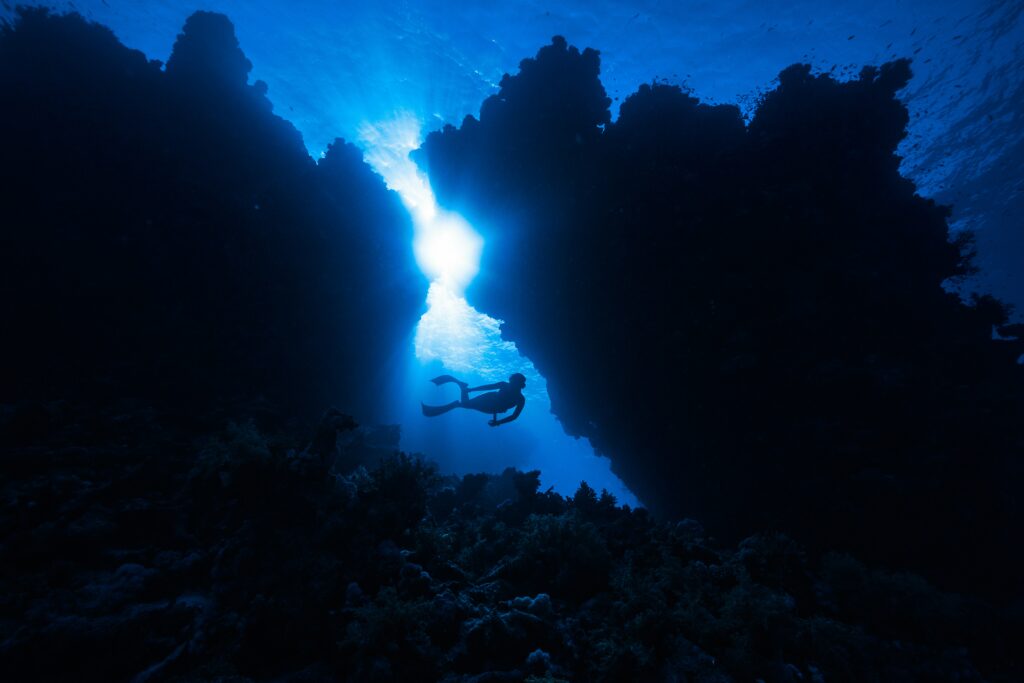
While simply sitting by the beach is therapeutic, descending beneath the waves takes mental restoration to an entirely new level. Scuba diving is, in essence, the ultimate form of moving meditation.
First and foremost, diving enforces a strict, non-negotiable digital detox. You cannot check Twitter, read news alerts, or receive frantic emails at 20 meters below the surface. Water is an impenetrable barrier to Wi-Fi and cellular signals. In a world where we are expected to be reachable 24/7, being underwater is one of the very few socially acceptable—and physically mandatory—excuses to be completely disconnected from the noise of humanity.
Beyond the digital silence, diving requires a mastery of breath control that mirrors ancient mindfulness practices. When diving, your breathing must be slow, deep, and continuous. This rhythmic inhalation and exhalation is practically identical to Pranayama (yogic breathwork). This specific pattern of breathing directly stimulates the vagus nerve, which activates the parasympathetic nervous system—the body’s “rest and digest” mode. It biologically counters the elevated heart rate and anxiety triggered by stressful news, flooding the body with calming neurotransmitters.
Finally, the underwater environment creates a unique form of sensory deprivation combined with hyper-focus. The chaotic sounds of the city are replaced by the rhythmic, Darth Vader-like sound of your own regulator. The pull of gravity is suspended, offering a sensation of weightlessness. To dive safely, you must remain acutely present. You are forced to monitor your air gauges, maintain your buoyancy, and observe the immediate marine environment—a vibrant coral head, a passing sea turtle, or a school of shimmering fish. There is simply no cognitive bandwidth left to worry about global politics or tomorrow’s boardroom meeting. You are forced to live entirely in the “now.”
Scuba Diving: The Ultimate Form of Moving Meditation
For residents of Saudi Arabia, this unparalleled mental health resource is located right in our backyard. The Kingdom boasts some of the most pristine, biodiverse, and visually stunning coastlines on the planet. From the bustling dive centers of Jeddah to the quiet, untouched reefs of Yanbu and Umluj, and stretching down to the Farasan Islands and up to the futuristic shores of Neom, the Red Sea is an accessible sanctuary.
There is a striking, beautiful juxtaposition at play here. Saudi Arabia is undergoing a period of hyper-development. Cities like Riyadh are transforming at a breakneck pace, driven by the ambitious goals of Vision 2030. The corporate environment is fast, demanding, and deeply intertwined with global economic shifts. Yet, just a short flight or drive away, the Red Sea remains a timeless, undisturbed ecosystem. Stepping from the fast lane of a rapidly developing metropolis into the slow, silent rhythm of a coral reef is a profoundly grounding experience.
This utilization of the sea for mental wellness aligns perfectly with the core tenets of Saudi Vision 2030, which places a heavy emphasis on enhancing the quality of life (QoL) for citizens and residents. The Kingdom’s massive push towards eco-tourism, the development of sustainable coastal resorts, and the promotion of water sports are not merely economic endeavors; they are the cultivation of a healthier, more balanced society that knows how to find refuge in its natural environment.
The Saudi Context: The Red Sea as a Local Sanctuary
The psychological benefits of diving do not end the moment you break the surface and climb back onto the boat. Divers frequently report a state of “post-dive clarity”—a lingering calmness that washes over them for days following an excursion. The physical exhaustion combined with the mental reset provides a clearer, significantly less reactive mindset. When you return to the surface world and eventually switch your phone back on, the news headlines often feel less sharp, less immediate, and more manageable.
Furthermore, the diving community in Saudi Arabia provides a unique social safety net. It is a diverse, inclusive group of individuals united by a shared passion for the ocean. On a dive boat, titles, corporate hierarchies, and political affiliations are left on the shore. Conversations revolve around marine life sightings, equipment, and shared experiences. This provides a incredibly healthy social environment completely detached from polarizing political debates, fostering genuine human connection.
Most importantly, the skills learned underwater can be translated directly into daily life. The mindful focus and the slow, deliberate breathing techniques practiced at 20 meters deep can be summoned in a bustling Riyadh traffic jam or during a tense moment reading the news. Divers learn that when panic sets in, the answer is always to stop, breathe, think, and act. This underwater mantra is a powerful tool for navigating the complexities of modern life.
Bringing the Peace to the Surface: Building Long-Term Resilience
We cannot control the shifting tides of the global political situation, nor can we silence the relentless roar of the daily news cycle. However, we maintain absolute control over how we respond to these external pressures and where we choose to seek our refuge.
The sea has been a constant, enduring presence throughout human history. It has outlasted every political era, every economic crisis, and every period of rapid societal change. It remains, as it always has been, a reliable anchor for our mental wellbeing.
In these noisy times, consider looking away from the screen and toward the horizon. Whether you book an introductory dive in Jeddah, plan a weekend trip to the Eastern Province, or simply spend a quiet hour walking along the Corniche to listen to the waves, the water is waiting. Take a deep breath, disconnect from the surface, and discover the profound healing power of the deep.
Conclusion
